Handling money is one of the first practical challenges you’ll face while traveling in Korea. You may need to ask a price, understand a large number in won, check whether a store takes cards, or ask for a receipt.
South Korea’s currency is the won (원), commonly shown with the symbol ₩. This guide gives you practical Korean currency vocabulary and phrases for real payment situations, with Hangul, Revised Romanization, and English throughout.
Table of Contents
Essential Korean Money Phrases
Start with these five phrases. They cover some of the most common situations you’ll encounter when shopping or paying for something.
| Korean | Romanization | English |
|---|---|---|
| 얼마예요? | Eolmayeyo? | “How much is it?” |
| 비싸요. | Bissayo. | “It’s expensive.” |
| 싸요. | Ssayo. | “It’s cheap.” |
| 카드 돼요? | Kadeu dwaeyo? | “Can I pay by card?” / “Do you take cards?” |
| 현금만 돼요? | Hyeongeumman dwaeyo? | “Is it cash only?” |
You can make 얼마예요? (eolmayeyo?) more specific by putting the item first. For example, 이거 얼마예요? (Igeo eolmayeyo?) means “How much is this?”
Here’s a simple souvenir-shop exchange:
Anna: 이거 얼마예요?
Igeo eolmayeyo?
“How much is this?”Shopkeeper: 오천 원입니다.
Ocheon wonimnida.
“It’s 5,000 won.”Anna: 카드 돼요?
Kadeu dwaeyo?
“Do you take cards?”Shopkeeper: 네, 됩니다.
Ne, doemnida.
“Yes, we do.”Anna: 네, 여기요.
Ne, yeogiyo.
“Okay, here you go.”
Understanding Korean Won Amounts
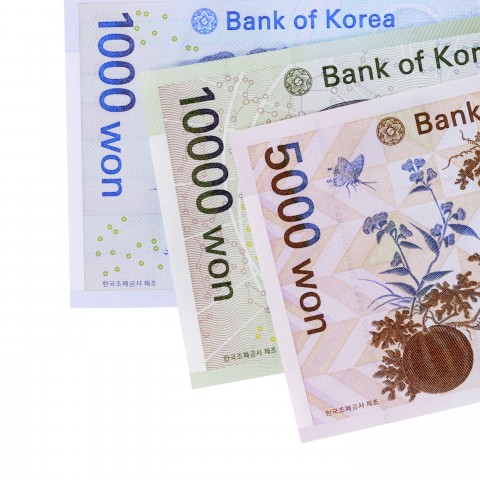
Korean prices are normally read with Sino-Korean numbers followed by 원 (won). The numbers may look large at first, but recognizing a few common units makes them much easier to understand.
The Key Unit: 만
The most important unit for larger prices is 만 (man), meaning “ten thousand.” Korean groups large numbers in units of 10,000, so 50,000 won is 오만 원 (oman won), literally “five ten-thousands of won.”
Here is a compact reference for common amounts:
| Amount | Korean | Romanization |
|---|---|---|
| 1,000원 | 천 원 | cheon won |
| 2,000원 | 이천 원 | icheon won |
| 5,000원 | 오천 원 | ocheon won |
| 10,000원 | 만 원 | man won |
| 15,000원 | 만 오천 원 | man ocheon won |
| 20,000원 | 이만 원 | iman won |
| 25,000원 | 이만 오천 원 | iman ocheon won |
| 50,000원 | 오만 원 | oman won |
| 100,000원 | 십만 원 | sipman won |
For prices, focus on these Sino-Korean forms. Native Korean numbers appear in other situations, such as 한 개 (han gae, “one item”) or 두 명 (du myeong, “two people”), but you do not need to master both systems just to understand a price.
For more audio practice with money vocabulary, see Korean Currency on KoreanClass101.com.
Asking and Understanding Prices
Once you know 얼마예요? (eolmayeyo?), a few variations will cover most shopping situations.
| Korean | Romanization | English |
|---|---|---|
| 이거 얼마예요? | Igeo eolmayeyo? | “How much is this?” |
| 다 해서 얼마예요? | Da haeseo eolmayeyo? | “How much is it altogether?” |
| 만 원 정도예요. | Man won jeongdoyeyo. | “It’s about 10,000 won.” |
정도 (jeongdo) means “about” or “approximately.” If you hear 만 원 정도예요 (man won jeongdoyeyo), the speaker is giving you an approximate amount rather than an exact price.
If Bargaining Is Appropriate
Do not assume every market or shop expects bargaining. If you’re at an independent stall where bargaining is clearly appropriate, this is a polite way to ask:
| Korean | Romanization | English |
|---|---|---|
| 혹시 조금 깎아 주실 수 있어요? | Hoksi jogeum kkakka jusil su isseoyo? | “Could you possibly give me a small discount?” |
Here’s a natural example:
Anna: 이 모자 예뻐요. 이거 얼마예요?
I moja yeppeoyo. Igeo eolmayeyo?
“This hat is pretty. How much is it?”Vendor: 이만 오천 원입니다.
Iman ocheon wonimnida.
“It’s 25,000 won.”Anna: 음, 조금 비싸네요. 혹시 조금 깎아 주실 수 있어요?
Eum, jogeum bissaneyo. Hoksi jogeum kkakka jusil su isseoyo?
“Hmm, that’s a little expensive. Could you possibly give me a small discount?”Vendor: 이만 원에 드릴게요.
Iman wone deurilgeyo.
“I’ll give it to you for 20,000 won.”
Cash or Card? Handling Payment
Credit cards are widely accepted at stores in Korea, but it is still useful to know how to ask about payment methods and to keep some cash as a backup.
| Korean | Romanization | English |
|---|---|---|
| 카드 돼요? | Kadeu dwaeyo? | “Can I pay by card?” |
| 카드로 할게요. | Kadeuro halgeyo. | “I’ll pay by card.” |
| 현금으로 할게요. | Hyeongeumeuro halgeyo. | “I’ll pay in cash.” |
| 현금만 돼요? | Hyeongeumman dwaeyo? | “Is it cash only?” |
| 카드가 안 돼요. | Kadeuga an dwaeyo. | “The card isn’t working.” |
| ATM이 어디 있어요? | ATM-i eodi isseoyo? | “Where is the ATM?” |
Here’s a cash-only example:
Leo: 다 해서 얼마예요?
Da haeseo eolmayeyo?
“How much is it altogether?”Cashier: 만 칠천 원입니다.
Man chilcheon wonimnida.
“It’s 17,000 won.”Leo: 카드 돼요?
Kadeu dwaeyo?
“Can I use a card?”Cashier: 죄송하지만 현금만 가능합니다.
Joesonghajiman hyeongeumman ganeunghamnida.
“I’m sorry, but we only accept cash.”Leo: 알겠습니다. 현금으로 할게요.
Algesseumnida. Hyeongeumeuro halgeyo.
“I understand. I’ll pay in cash.”
Cards are accepted at most Korean stores, but some smaller sellers and some transportation-card purchase or top-up situations may still require cash. Carrying some won as a backup is therefore useful.
If you’re exchanging money at a bank or exchange counter, you can also ask:
| Korean | Romanization | English |
|---|---|---|
| 환율이 어떻게 되나요? | Hwanyuri eotteoke doenayo? | “What’s the exchange rate?” |
Because exchange rates change constantly, it is better to check the current rate when you need it rather than memorizing a fixed won-to-dollar conversion.
Tipping, Change, and Receipts
A few final phrases can make checkout smoother.
Tipping: Tipping is generally not expected in Korea. At restaurants and in taxis, you normally pay the stated amount without adding a tip.
Change: The Korean word for monetary change is 거스름돈 (geoseureumdon).
Receipts: If you need a receipt, 영수증 주세요 (yeongsujeung juseyo) is a simple, useful request. You may also hear a cashier ask 영수증 필요하세요? (yeongsujeung piryohaseyo?), meaning “Do you need a receipt?”
| Korean | Romanization | English |
|---|---|---|
| 거스름돈 | geoseureumdon | “change” |
| 오천 원 거슬러 드릴게요. | Ocheon won geoseulleo deurilgeyo. | “I’ll give you 5,000 won in change.” |
| 영수증 필요하세요? | Yeongsujeung piryohaseyo? | “Do you need a receipt?” |
| 영수증 주세요. | Yeongsujeung juseyo. | “Receipt, please.” |
| 감사합니다. | Gamsahamnida. | “Thank you.” |
Here’s a final checkout exchange:
Cashier: 오천 원입니다.
Ocheon wonimnida.
“That’s 5,000 won.”Anna: 네, 여기 만 원이요.
Ne, yeogi man wonieyo.
“Okay, here’s 10,000 won.”Cashier: 오천 원 거슬러 드릴게요. 영수증 필요하세요?
Ocheon won geoseulleo deurilgeyo. Yeongsujeung piryohaseyo?
“I’ll give you 5,000 won in change. Do you need a receipt?”Anna: 네, 주세요. 감사합니다.
Ne, juseyo. Gamsahamnida.
“Yes, please. Thank you.”
Ready to Handle Payments in Korea
You now have the core Korean currency skills a traveler needs: asking a price, understanding common won amounts, checking whether cards are accepted, paying in cash or by card, and asking for a receipt.
For more practice asking prices in a real shopping dialogue, continue with How Much Korean Money Can You Spend in a Day? on KoreanClass101.com.